Safari, so good
Limpopo, South Africa

By Prioleau Alexander
Our African safari began as most great adventures do: With drinks.
It goes like this: The team from a newspaper I write for attended a Quail Forever banquet, organized and hosted by fellow writer Tim Askins. Tim asked your humble scribe to serve as the keynote speaker, and given my speech centered on insulting everyone present, the thought occurred to me it might be best to be… you know, limber.
In addition, I knew the entire audience would be a few bracers deep, so it would be best to achieve a similar mental groove. Selfless of me, yes — but those who know me know that giving is what I’m all about.
The speech was well received, and the buzz of applause in my brain led me to think I deserved a few more cold ones.
The live auction began, and my bride Heidi made the mistake of running out to the car. Items came and went, and just when I reached the point of yoga-instructor limberness, an African safari came up for bid. A safari for four in the Limpopo Province of South Africa, at Leadwood Ranch, home of Wild African Safaris.
Cutting my eyes to the right, Gus Smythe came into view, seated alongside his wife Eleanor. My need to write a new travel piece with Gus in tow put a blind spot in my brain where my finances are filed. My hand went up … then up again … then up again, and … just then, Heidi returned.
Tim announced I was the winner, and the crowd applauded. Heidi beamed and asked, “Did you buy that duck print we like?”
Gus and his bride Eleanor turned and looked at us, jaws on their plates, just now realizing Heidi had been absent during the bidding.
“Not … exactly,” I replied. “Something better — and very practical. Speaking of practical, they practically gave it to us! It would have been practically stupid not to buy it!”
“And?”
“You, me, Gus, and Eleanor are going to Africa!”
“What???” said Heidi.
“Oh, Good Lord,” said Eleanor.
“I’ll be at the bar,” said Gus.
In defense of my “clouded” decision, I can say the trip was purchased for about one-third of its actual cost. Sure, this wouldn’t be 2-Star adventure—but if you’re going to go on safari in Africa, we certainly scored a 2-Star price.
*******
Like all my adventures with Gus, things went sideways from the jump.
We arrived at the airport, and the Queen of Karens behind the counter announced with passive-aggressive glee that there was no ticket for Gus Smythe. I advised her of my conversation with our travel agent the night before, and everything was cooked, booked, and ready to roll. Our battle reached a fevered pitch before I broke, and called our travel agent. She slogged through the data, and gave me the confirmation number.
“Oh,” said our counter crank, “No wonder I couldn’t find it. His name is misspelled. Symthe.”
You would’ve thought the misspelling wasn’t Symthe, but Mohammad Bin Laden Mohammed. Brevity demands skipping much of the sarcasm and bitterness spewing back and forth, but we finally found our way onto the plane, and the stewardess offered us all one of those alcohol wipe packets.
“What’s this for?” Gus asked. “Protection? What kind of flight am I getting on?”
We made our way to our seats.
“Mr. Smith? Mr. Augustine Smith?” said the stewardess walking down the aisle.
“I’m Mr. Smythe,” Gus responded.
“Could you please follow me to the front?”
Thirty seconds later, Gus was standing in front of the Captain. I followed and stood at a distance, of course, because how could I not?
“Look, in the future,” the Captain said, “when you board the plane, we need you to give us your paperwork, and let us know you’re here. It’s rare to have someone onboard who’s armed, and we need to know exactly where the gun is in. Do you have the paperwork?”
“Captain,” Gus replied, “That was a most excellent presentation, but I’m just a guy with a boarding pass— all of my firearms at home.”
“Good Lord,” the Captain replied, “how the hell did you get marked as an air marshal?”
Gus and I looked at each other.
“I’m guessing if you find our counter agent, you’ll find that answer.”
*******
A little background:
Around 1650, some Dutch sailors passed the Cape of Good Hope at the tip of South Africa, and decided to set up shop and sell supplies and grog to other ships stupid enough to sail around the Cape of Good Hope. Why it’s called Cape of Good Hope is believed to be a mistranslation of Dutch to English, or perhaps an inside joke amongst the Dutch, because the real name should be Cape of No Hope. Over the centuries, more than 3,000 ships have foundered there, and unless you view treading water until a Great White rips you to shreds as “good” not “bad,” then—whatever. There’s nothing “good” about that particular cape.
In 1795, the British invaded and took South Africa, then for some reason gave it back to the Dutch in 1803. Legendary Indian-givers that they are, they took it back in 1806. How you take back a country you gave away is a mystery to most, but they did.
The Dutch immigrants, now called Boers (which means “farmers”) were entirely unimpressed with all the hip-hip and stiff-upper-lip crap the Brits are known for, and migrated away from their area. They founded a couple colonies, which the British recognized, but we know how Brits are when it comes those kinds of deals.
Unfortunately for the Boers and the natives, South Africa offered more than just fertile soil… gold and diamonds were discovered as well. The surest way to get colonized is to tell a European country that there’s a place with natural resources and people who haven’t heard of Jesus.
This duel discovery causes British minds to react in tumultuous ways, and the only way to soothe the savage beast is to embrace “the White Man’s Burden,” which is a burden of seizing and owning all the non-dirt things. Thus, it goes without saying the British took back the Boer colonies they recognized as not theirs.
In October 1899, war began in South Africa between the Boers and the British. The Boers enjoyed some early success, but more British troops arrived, and the Boers were pushed back. The Boers then turned to guerrilla warfare, which usually works—ask the Viet Cong and the Taliban. Lord Kitchener, the British commander, decided to strike back in the gentlemanly fashion so often practiced by the POMs, and began herding Boer women and children into concentration camps, where more than 20,000 of them died of disease. The Boers finally surrendered.
South Africa became a segregated society, and the Black Africans were barred from voting. Eventually, this issue became an opportunity for celebrities to run their cake holes about other people’s business, and inspired them to write stupid songs like “Ain’t Gonna Play No Sun City.” The Whites, of course, didn’t give a crap about the opinions of people who play dress up and pretend for a living, much less people who can play a total of three guitar chords and sing through an auto-tuner. However, when the world began sanctioning South America and they couldn’t get iPhones, the law changed to one-man-one-vote.
Sadly, this has resulted in government officials almost as blatantly corrupt as America’s, except, of course, in South Africa corruption is at least illegal. In America, our politicians are required to fill out forms exposing their exact level of corruption, which are then made available for everyone to see.
The tumultuous history of South African does not change the fact that for centuries, the continent of Africa has called out to the wild-at-heart. Explorers, pioneers, and missionaries alike have responded to the irresistible pull of the Dark Continent, and thousands have discovered that, once there, the magic of the place seeps into ones soul. It is a world apart from the Western mindset, where beauty, adventure, and mystery meld to offer an experience that tantalizes the mind, body, and spirit. Nothing can quite compare to the experience that is Africa…. especially when your wingman is Gus Smythe.
*******
Arriving at a place like Leadwood Ranch is quite a shock for someone who feels like a bigwig upgrading from the Dew Drop Inn to a Motel 6. People with homes on the front beach of Malibu only dream of this level of living. A sprawling thatch roofed deck, a pool, two outdoor dining areas, private cottages for every couple, and an outdoor cabana bar overlooking a vista of mountains and a massive lake, filled with crocodiles … so many crocs, you could see some of the massive ones clear as day. At 18-feet feet long, they’re hard to miss.
Our hosts, Glen and Charmaine Janse van Rensburg, greeted us with champagne in a viewing area above Death By Crocodile Lake and proceeded to give us a tour of where we’d spend the next ten days.
“Can I swim in that lake?” Gus asked.
“Just as soon as you sign the liability waiver,” Glen replied.
After taking a few minutes to settle into our movie-mogul accommodations, our Professional Hunter (guide) for the week, Ruan Smit, took us on a tour of the ranch to give us a look at the variety of game that roamed the property. Ruan was a mountain of man, and had a cool South African accent… he looked like the kind of guy who’d take the hit from a Cape Buffalo before he let it connect with his client.
“Will we see a giraffe?” Gus asked. “I told my daughter I was going to shoot a baby giraffe, so when I had it stuffed it would fit in her room. She cried a little, but I told her not to worry — if it didn’t fit, I’d saw the legs off.”
“I’m kidding — I don’t really want to shoot a giraffe,” Gus added. “I’m here to take a moose.”
“We don’t have a moose,” Ruan replied, a bit concerned about the mental facilities of his new wards
Gus looked my way, then back at Ruan.
“And you were going to tell me this when? I flew halfway around the damn world and I don’t get to hunt a moose?
All of us — minus Gus — began to feel sorry for Ruan. It was going to be a long ten days.
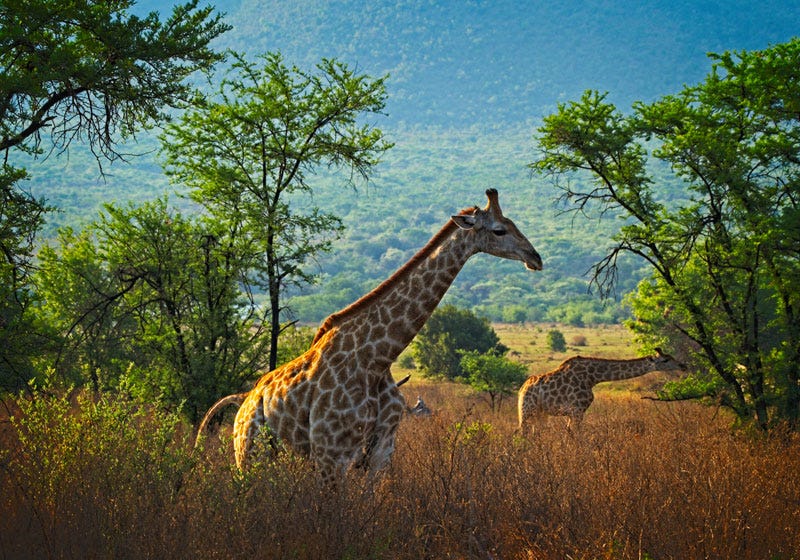
During our tour of the gigantic game preserve, we saw rhinos, kudu, wildebeest, crocs, impalas, waterbucks, nyala, baboons, giraffe, mongoose, zebras, honey badgers, skin bucks, and Cape buffalo. We saw them, but didn’t locate them — fortunately we had Ruan for that.
“If you look through there, you can see a bull giraffe.”
Speaking the question we all shared, I asked, “Where?”
“Right there.”
“Where?”
“Right there.”
“Right there where?”
“About 50 meters in.”
For those unaware, as we were, an animal the size of a school bus can stand in the bush 50 meters away and remain invisible.
“Oh, there!”
“You see it?”
“No.”
Patiently, Ruan talked us through the necessary steps to actually see the giraffe, steps he necessarily took for every animal we saw, except for a pair of baboons who tried to climb in the truck and mooch some Cheetos.
We came across a gate to the property, and Roan informed us someone left the gate open a week earlier and a couple rhinos wandered off and went on a walkabout up the highway. They had to dart them with a sedative, then lead them by the horn back onto the property. I didn’t tell him about the time I left our door open and our dog ran off for a bit.
“Are you going to hunt today?” Ruan asked. “Maybe a Cape buffalo?”
“I’m going to hunt a buff,” I said to Heidi. “I heard they’re dangerous.”
“I’ve had two friends killed by buff in the last year,” Ruan said.
Most people are aware of what a Cape buffalo looks like, but in the event you aren’t… it looks like Satan said to his design team, “All of God’s animals are too peaceful looking. How about design me something that looks like, well… it emerged from the bowels of Hell.”
With some males weighing in at 2,000 lbs., with a shoulder height of six feet, and length of about eleven, Cape buffs are chiseled out of granite and muscle, and maintain a resting-kill-face even while napping. It’s said you can kill a Cape buff… it’s just hard to convince him he’s dead. One of the reasons for this is his horns grow across the top of his head and forehead, forming a shield called a “boss,” and most caliber bullets simply bounce of the boss.
While the bulls are largely solitary, the cows live in herds, and woe is to the animal that raises their ire—they counter-strike attacks as a team, and a team of Cape buff mommas protecting their kiddos is not something you want to play defense against. There is a famous video called the Battle at Kruger (on YouTube), where a herd of buff wander upon a pride of lions—the lions charge, and the herd scatters, but the lions manage to cull a calf from the herd and take it down on the edge of the river. Seconds later, there are three lions with their jaws on the calf, attempting to drag the calf out of the water.
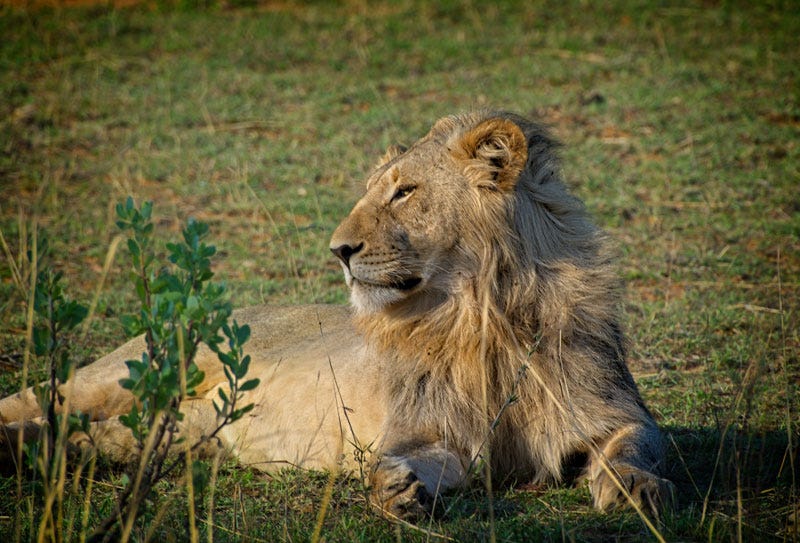
Just to add some spice to the battle, two crocodiles swim up, and latch onto the calf’s rump. A tug-o-war ensues, and the lions win. There are now five lions preparing to eat the little fellow, when the herd of buff return. From there it’s fur and dust and lions flying through the air.
While the herd chases the scattering the lions, the calf—that little dude who was attacked by three lions and two crocs—hops up and trots into the protection of the herd.
Like I said, forged in Hell.
“Okay, no Cape buffalo.” Heidi said. “How about my husband just hunts animals that can’t kill him.”
“That’s a small list,” Roan replied.
We returned to the lodge for drinks and a dinner of kudu steaks. We turned in earlier than usual—11:55 instead of midnight—because the following morning we were headed out for a two-day adventure in Kruger National Park.
***********
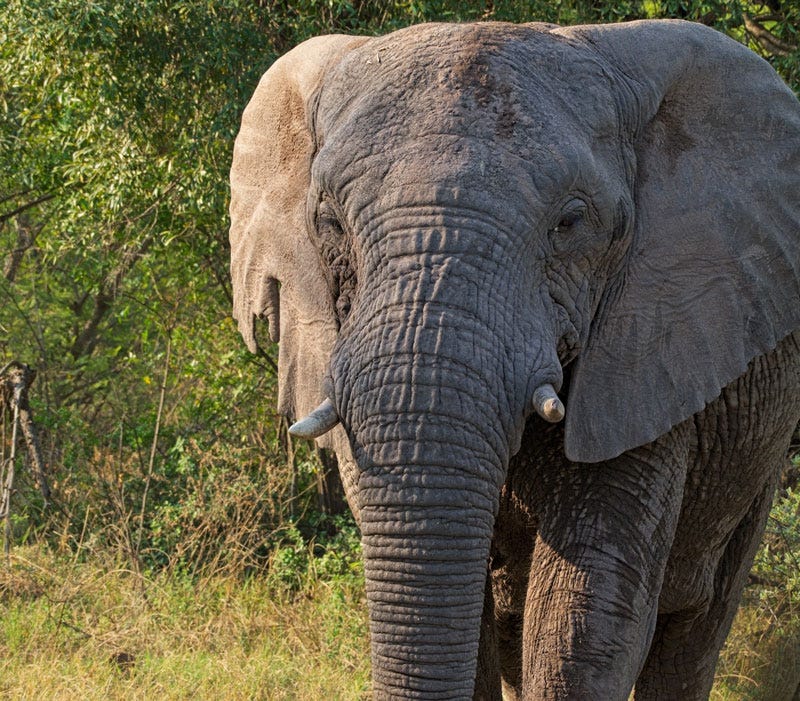
Kruger is big. Like, it takes eight hours to drive across it big. The terrain is a bit like what we Americans would call high desert, but covered in swaying lion-colored grass and miles of vegetation best described as “angry-looking trees” and “bushes in a very bad mood.” Many of trees looked like they’d been in a fight with an elephant, which in fact they had. Charmaine came along as our guide, and explained the damage done by elephants is the reason many private ranches don’t maintain elephants on the grounds.
Charmaine knew the park like the back of her hand, and our first stop was a watering hole, where three massive elephants were having drinks and catching up on the latest gossip. (Did you see how much weight Lilly gained over Christmas? I know—I’m so jealous. What a bitch.)
We responded to the site of these majestic animals as any sophisticated American would: “Holy &%$#! That’s an elephant! It’s, like, right there!”
We loitered for about fifteen minutes, taking pictures and saying stupid things about documentaries we’d seen. Charmaine laughed, and told us that before we left, we’d have seen so many elephants we’d be saying, “No need to slow down. It’s just another elephant.” No way, right? [One quick thought: When encountering an animal as majestic as an elephant, there’s no need for four people to each take 100 photos from the same angle.]
The next animal we encountered was a nine-foot-tall ostrich, a hilariously awkward and harmless-looking bird. Charmaine proceeded to tell us they were quite dangerous, and sometimes deadly.
“That would suck to have in your obit,” I opined. “Pecked to death by an ostrich.”
“When they get hormonal, they can be quite wild. Their kick is vicious.”
“I know about wild, kicking, hormonal animals,” Gus said. “I have three sisters.”
We arrived at a small restaurant to eat lunch. We ordered, and relaxed as we watched the monkeys play in the trees. After a quarter of an hour, our waiter returned.
“Your order may take a while. There is no electricity.”
“How long will the electricity be off?” Charmaine queried.
“We estimate three hours.”
“I’m gonna go out on a limb,” Gus said, “and guess the grill is a gas grill.”
“Yes,” the waiter said, “but we cannot cook your onion rings.”
“I’ve had some good onion rings,” I said, “but none I’d wait three hours for. Maybe you could just cook the stuff that involves the grill?”
Before long, we were dining on our buffalo burgers.
******
The lodge where we stayed the night in the Kruger was magnificent. Endless decks ran along a river’s edge and big fluffy couches called to our rumps. One of the attendants pointed to a large mass up the river, and explained it was an elephant that died, and they dragged it into the river for the crocs.
You flat know you’re not in Kansas anymore when you look through binoculars, and watch massive crocs eating an elephant. I carefully inspected the height of our decking, as compared to the bank of the river. Unless the crocs had wings, I felt pretty safe.
A young man named Andre showed us to our private bungalow. The front door was covered by a large canvas, which he unzipped to reveal French doors boasting two different styles of latch locks, plus a door knob.
“Be sure to lock the doors and zip the canvas closed when you leave. We’ve had a problem with the baboons breaking in and stealing people’s bags—we found one guest’s iPad about two miles away. They figured out the door knob, so we added a hatch lock. They figured out that lock, so we added another one. They figured that one out, so we added the zippered canvas. We think we’ve got them beat now.”
After Andre departed, Heidi and I looked around the room, and reveled in its luxury. It had the whole Out of Africa thing going on—dark wood walls and floors, a four-poster bed, mosquito netting. Quite beautiful.
To our surprise, we heard the tent being unzipped, and assumed Andre forgot to tell us something. Nope. It was a baboon, preparing to flip the locks and make himself comfie in our little bungalow. I yelled and jumped, Heidi screamed and hid, and the baboon shrieked and ran.
“I’d rather you be the one,” Heidi said, “to break the news to the baboon security team.”
We walked up to the dining area for drinks and enjoyed another gourmet dinner of ground impala lasagna. The sun set slowly over the trees across the river, and put on a show of melting pastels. As if the trip wasn’t ticking off enough boxes on my bucket list, I got to admire the Southern Cross as we ate.
*******
The following morning, Charmaine took us on another drive-about in search of game — and damn did we hit pay dirt. Elephants, zebras, Cape buffalo, wildebeest, impala, waterbucks, hyenas, baboons, hippos and crocodiles were everywhere.
One route took us along a beautiful riverbank where the vegetation was lush and lined with trees. It seemed to be another world from the terrain just 400 yards away from the river.
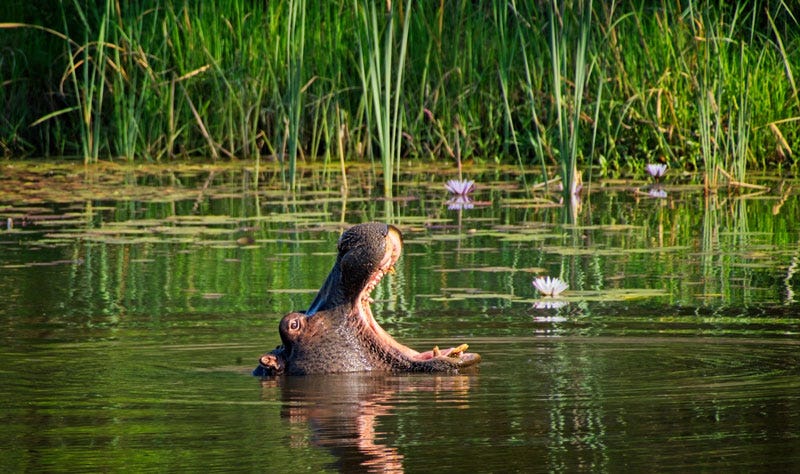
At one point we rounded a bend, and below us was a bloat of 17 hippos, standing alongside the river—several were mommas with their calf.
“They’re so cute,” Eleanor said.
“Hippos are responsible for the most deaths in Africa each year,” Charmaine explained.
“You know,” Gus said, “I’ve read Ted Bundy was quite cute. Maybe it’s one of those cross-species genetic anomalies.”
“Your friend, Gus,” Charmaine asked me, “is he … okay? Am I … safe?”
A short time later we happened onto a momma giraffe with her calf.
“Stop!” I barked. “I want to get out and take a picture!”
“Pree-loo,” Charmaine said in her soft Afrikaans lilt, “I told you we cannot get out of the car.”
“But why?” I pleaded.
“Because we are not in a zoo. Animals are behind every bush, and you could be trampled or gored or torn to pieces and eaten.”
“Those are all bad verbs,” Gus noted.
A bit further up the road, a momma elephant damn near stuck her trunk in the passenger window, and cut loose with a tinnitus-inducing trumpet. After we managed to crawl back into our skin, Charmaine reversed her truck to see what caused all the racket. There, ten feet away, as the baby momma was protecting. There are occasions when you see God, and that moment was one of them.
The day flew by as we stared in wonder at herd after gang after bask after bloat after tower after pride after troop after zeal. As the sun set, we headed back to the ranch.
Oh, and Charmaine was right — on the way out we merely glanced at the elephants as we drove past them on the way back to the ranch.
********
I was up the next morning at the crack of noon. The evening before we’d engaged in the nightly Happy-five-Hour, and much merriment was made. Hunting the same time as us was a grandfather/father/son combo, and being good Christians they did not imbibe. I saw the grandfather look our way from across the pool and I’m pretty sure he said to his offspring, “You see? That’s what consumption does to a potentially normal human.”
At 2 p.m., our guide Ruan announced it was time to go to the rifle range to site the guns. We’d decided to, instead of dealing with the hassles of TSA, we’d just use the guns they had available. My was a 30.06 with a suppressor, which reduces the recoil by half and reduces the noise to a Bourne Identity kind of crack.
“Are suppressors hard to get in South Africa?” I asked. “In the States, it takes over a year and a background colostomy by the Feds.”
“No,” Ruan said, “it’s easy. You just buy one.”
“Could I buy one?”
“Sure. Next time you come, send me the measurements for the threading in advance, and I’ll have it waiting for you.”
At no point in my life have I ever wanted to scream more. With my inside voice I bellowed, “Why wasn’t this %&$^ information given to me in advance???” But, as I said, Ruan is a large man, so I simply replied I’d do so.
Gus’ shots proved better than mine, and that’s a big deal in the man-code.
“Heidi,” I said sadly, “Gus’ marksmanship has proven he is the superior provider. I understand if you choose to leave me, and take him as your husband.”
Fortunately, Heidi is unaware of this code all shooters share, and asked me if I was having a sunstroke.
When 4 p.m. arrived, it was time to head afield in search of animals. Our goal was to find an impala, wildebeest, or a warthog. The ladies came along, and we drove the ranch while Ruan and our tracker Thomas did this magical thing called “actually seeing animals.” This entails peering into the thickets about 50 yards at 10 mph and spotting an animal’s hoof behind a hoof-colored bush covered in hoof colored grass.
We all helped by not seeing any animals.
After about an hour, Ruan spotted an impala. I exited the truck and took the shot; blessedly, it was true, and the impala dropped. The entire enterprise took 30 seconds. Being the calm, cool, and experienced hunter I am, I bellowed to Heidi, “Woman! You no gather roots and berries today — me hunt successful! I am Alpha!”
It was an honor and a thrill, and wonderful to know that we’d soon be dining on the impala. There is a tradition of honoring a hunter’s first kill by spreading a small amount of its blood on the hunter’s cheeks. In South Carolina, this is reserved for youngsters who’ve harvested their very first deer… but this was my first hunt in Africa. As a result, Ruan bloodied my cheeks and said, “You’ve taken your first African animal. You can now hunt here forever.”
I understand, of course, some non-hunters find our passion of hunting to be simply killing “innocent” animals, but they really have no say in the matter unless they’re vegan. After all, there aren’t any beef cattle in a West Texas feedlot waving a hoof at the slaughterhouse and mooing, “Butcher me next. I’m guilty of numerous crimes.”
That evening, the four of us retired at the same time. The evening was cool, and when Heidi and I crawled into bed, we found a warm water bottle at our feet. Delightful. A few minutes later, we heard a sound not unlike an elephant trumpeting, then saw a white man in madras boxers streaking past our room at a speed Usain Bolt only dreams of. He was screaming what sounded like, “Get a gun! A big huge gun! Cobra in my bed! Cobraaaaah!”
Gus, it seemed, discovered the water bottle.
******
The next morning I entered the early morning world I rarely inhabit; I stopped getting up at dawn when you taxpayers quit paying me to do so. It felt odd. What sane person gets up earlier than God intended? Add into that equation getting up early with a hangover, and you have the formula for a textbook psychopath.
When I emerged from the room, small waterbucks grazed on the estate’s lawn. Smart fellows—perhaps they know there is an unwritten code among hunters that “lawn deer” are off limits, no matter how big or tempting. If word of such got out via the gruntagraph to the greater population of animals on the massive ranch, the lodge area would look like Noah’s Ark.
While eating breakfast, we heard a dog yelp, followed 30 seconds later by a gunshot. A few minutes later, Charmaine arrived, sat down with us, and poured herself a cup of coffee.
“Uh, Charmaine?” I asked, “what was that?”
“Oh, the shot?” she replied. “Spitting Cobra on the back porch. Spit some venom in Boogie’s eyes. So I shot the Cobra, washed Boogie’s eyes with milk, and here we are—all good.”
“I’ll have to check my files,” Gus said, “but I don’t think Spitting Cobras were listed on the liabity waiver.”
We went out at 7:15 to search the area for Gus’ preferred trophy, a wildebeest. Our guide Ruan was as upbeat and ready-to-go as he was every day, which couldn’t have been easy. Over the past two days he’d put us in a position to harvest dozens of the most elusive and desirable game on the ranch but … well, the more desirable and rare the animal, the more the permit fee. Ruan would’ve been providing the hunt of ten lifetimes to a rich hunter, or a middle-class hunter willing to dip into their Muffy’s college savings account.
As Gus and I are both “between fortunes,” we opted to hunt the plentiful and inexpensive animals. Impalas have an “M” on their hindquarters, which apparently stands for McDonald’s, because every carnivore in Africa views the impala as not-fast-enough food. We hunted until lunchtime, and returned to the lodge for another exquisite meal.
Charmaine joined us for lunch, and asked how our week was going; I realized now was the time to make my big requests.
“Everything has been perfect, but I want to meet a Pygmy, see some thatched huts, one of those chicks with the really long necklace necks, and some of those dudes that can jump really high. A witch doctor with a bone through his nose would be a huge bonus.”
“Pree-loo… you are in the wrong country for those things.”
“If you have lions and elephants,” I explained, “you have to have at least thatched huts and some jump-high dudes. I read it on the Internet.”
“I’m very sorry,” Charmaine answered.
“Okay, I said. “I’m always looking for a side hustle. If I built a village and paid some the long neck gals and a witch doctor to move here, do you think it could make some jack? As a tourist attraction?”
She did not. Still, I made a note to discuss it with some investors back stateside.
******
Our next hunt went beautifully — Ruan spotted a wildebeest, and he and Gus headed into the bush. Shortly thereafter, we heard a shot, then Gus and Roan emerged.
“Did you drop him?” I asked.
“It’s very hard to kill a wildebeest with one shot,” Ruan explained. “We’ll track him now. May take a bit — we call wildebeest ‘the great Realtors,’ because when you’re tracking them, they take you to real estate you didn’t even know you owned.”
Gus and the trackers disappeared into the brush. Gus would later tell me watching them work is like watching the FBI state that deleting 30,000 emails and smashing your cell phones with a hammer isn’t a crime: It’s happening in front of you, but you can’t believe your eyes. The trackers communicate via bird-sounding whistles, circle back and forth, spot drops of blood, and follow the animals actual tracks. How do you track a wildebeest when ten other wildebeests’ tracks are intermixed? If you know, send me an email, because I sure don’t know.
The tracking efforts took a couple hours, as African animals are forged from steel. Eventually we heard a shot, then ten minutes later a tracker emerged from the bush to take us to Gus, Ruan, and the animal. Ruan followed tradition and bloodied Gus, who beamed with excitement. It was a glorious occasion, all around.
My quest for a warthog didn’t go as well. I thought those little dudes would wallow in the mud and throwing themselves at me, but they are flighty. The ones we saw were too small, and running like Hunter Biden to an illegal business deal.
I said to Ruan, “Those little bastards are hard to pin down, eh?”
“You’ve got to remember,” he replied, “they’re like Impalas-- every carnivore in Africa eats them. Crocs, lions, leopards, hyena…”
“That makes sense,” Gus said. “They’re made of bacon.”
*****
The following day we arrived at a blind overlooking a watering hole. As we sat, we saw a small herd of Impala strolling into the thick brush and out of sight. Ruan growled, and said, “Dammit. They heard the truck stop.”
“At least they could have the decency to run,” I said. “You know, already be in the brush when we get into the blind … strolling away and making sure we see them leaving is rude as hell.”
Ruan and our tracker Thomas thought that was quite funny.
One thing many anti-safari-hunting misunderstand is the hunting aspect of a safari… I did, too before we got here. The feeling is that people on hunting safaris drive out into a pasture, where they encounter a noble lion, hogtied and staked to the ground. The hunter shoots him in the head, and is driven back to lodge for martinis.
That’s just not the case. The hunt goes on all day, and the animals are smart, camouflaged, and very much intent on making it to bedtime. If the wind shifts, and you’re upwind of an African animal, that part of the hunt is over—they can smell you hundreds of yards away. Everyone but the Rhinos have incredible eyesight, which might explain why Rhinos have “trample now, ask questions later” outlook on life. You can hunt for days, and never see the animal you’re looking for. And there surely isn’t a “no kill no pay” policy like you find in some American hunting preserves. In Africa, it’s fair chase, and if you never have a shot at a specific species you’re hoping for, well, there’s always next year.
It also impressed me that the Leadwood Ranch policy was no taking of the females or bucks that don’t measure up. Americans have no clue regarding the sizes among something like Kudu, and what the difference is between a “big bull” and a “slightly too small to shoot bull.” It would be quite easy for an unscrupulous outfit to simply identify a bull “a little too small,” but allow the hunter to take it—in order to make the client happy.
No way that’s happening at Leadwood Ranch.
As we headed back to the lodge, we passed through an area of great hills, and a number of cliffs.
“Right over there is where we lost a young breeding Buffalo we bought. We had great hopes for him.”
“How often does a Buffalo fall off a cliff?” Eleanor asked.
“Never”
“What a yo-yo,” Gus chimed in. “Maybe it’s for the best — you don’t want those Three Stoogenes to spread too far.”
That evening, we ate my impala’s tenderloins, and afterwards gathered around the firepit, where Ruan regaled us with tales of past hunts, fair and foul. Both Gus and I yearned to regale back, but the only game in South Carolina is Whitetail deer—and the only time they’re dangerous is when they hurl themselves out of the woods and into the path of your truck.
*****
Prior to leaving for South Africa, the four of us spent two weeks and emptied our paltry checking accounts by purchasing the most stereotypical safari gear one could imagine… we searched for images from the movies Out of Africa, White Hunter Black Heart, Breaker Morant (a film about the Boer Wars.) We checked out photos of Teddy Roosevelt. And as a result, our suitcases were stuffed with khaki, pith helmets, knee high boots, and classic safari jackets.
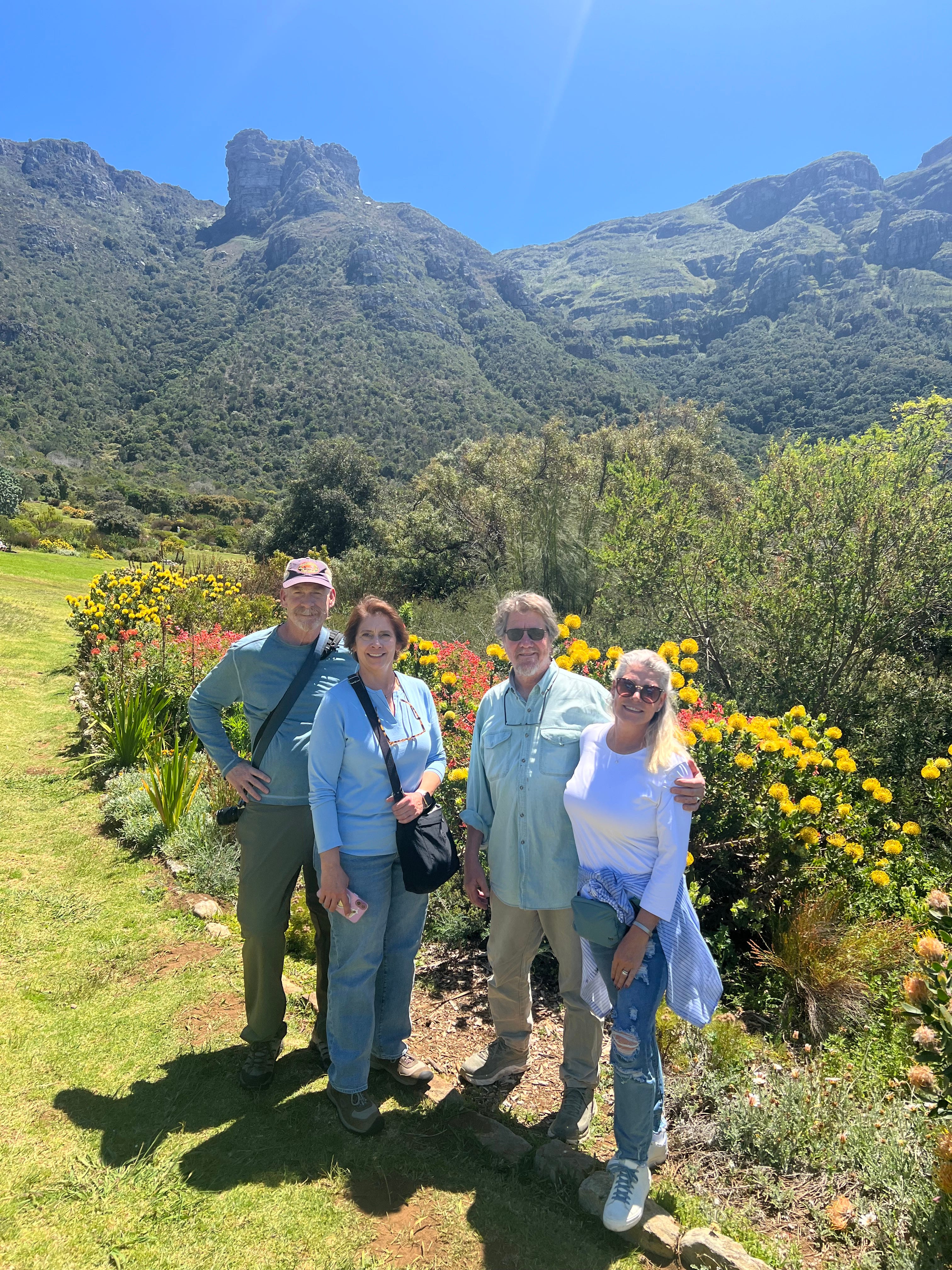
You’d need to see a photo to understand how awesomely stupid we looked.
The morning we emerged in our classic attire, Gus and I went sat down for breakfast and rolled into our “I say old chap” routine, and began quoting the movie Breaker Morant: “We were out on the veldt fighting the Boer as the Boer fought us. We caught them, and shot them under Rule 303.”
Ruan chuckled and said, “Just so you know, everyone in this region descends from Boers. No Brits.”
After a moment of reflection, Gus said, “I knew it! None of you look like fancy pants pillow-biters. We’re dressed as Boers who’ve recently slaughter thousands of Limmies, and… we’re wearing the uniforms as a joke. In fact, I punched one of those British window lickers in the face before we left the airport.”
“I married a Brit I met in Cape Town,” Ruan said.
“And I bet she’s a woman of refinement, beauty, taste, and royal heritage. A real catch!”
“I divorced her last year.”
“And well you should have! She probably didn’t understand the rich and proud history of Boers. I hope you sent her back to that stinking island penniless and in disgrace.”
“No, she’s here. So’s my daughter, who’s a British citizen.”
“Ah, yes—the British Empire! The sun never set on that glorious empire, built from the ground up by… I’m gonna shut up now if that’s okay.”
“By all means,” Ruan said, “carry on. It’s getting fun.”
********************
Our time in South Africa came to an end, and we found the hardest part about leaving was the fact we weren’t just leaving a place filled with fun and beauty… we were leaving new friends. Charmaine, Glen, and Ruan aren’t simply an amazing staff at a great resort… we lived with them, dined together for every meal, enjoyed after-dinner drinks, hunted with them, and absorbed a lifetime of new insights. No fewer than a dozen ribs were bruised from the laughter.
It is hard to say what is most unforgettable about Africa — it’s fascinating people, dramatic geography, or free-ranging wildlife — but for most of the world, the continent’s fame is as a result of its four-legged inhabitants. The good news from the front is that most of the non-profit hype to Americans concerning “coming extinctions” is simply a heartstrings money grab. All of the “Big Five” — lions, leopards, elephants, rhinos and giraffes — are maintaining healthy and sustainable numbers. Their numbers are growing, not shrinking. Another interesting fact we learned that the Leadwood Ranch, at 12,000 acres, is “too small” to have a lion. Those critters obviously need a lot of space, which helps explain why the population is doing so well.
Oh, and as FYI, I think it would take it would take 1,000,000 hunters 1,000 years to put a dent in Africa’s plains animals’ population.
This is, of course, due to conservation practices of the ranch owners who own these animals, and the government who enjoys the tourism money and the hunting taxes and fees. It would be the definition of insanity to hunt your animals in a way that depletes your source of income. The only negative impact on the herds across Africa comes from poachers, and corrupt police are believed to be a part of that problem. Instead of “adopting an elephant for only $14 a month,” the better play would be to “adopt a sniper to end the poaching.”
Charleston’s own Bill Murray is reported to have said, “They say an elephant never forgets. What they don’t tell you is, you never forget an elephant.”
True words. Go and see for yourself.