Thoughts While Walking Across Spain
Dispatches Along the Way

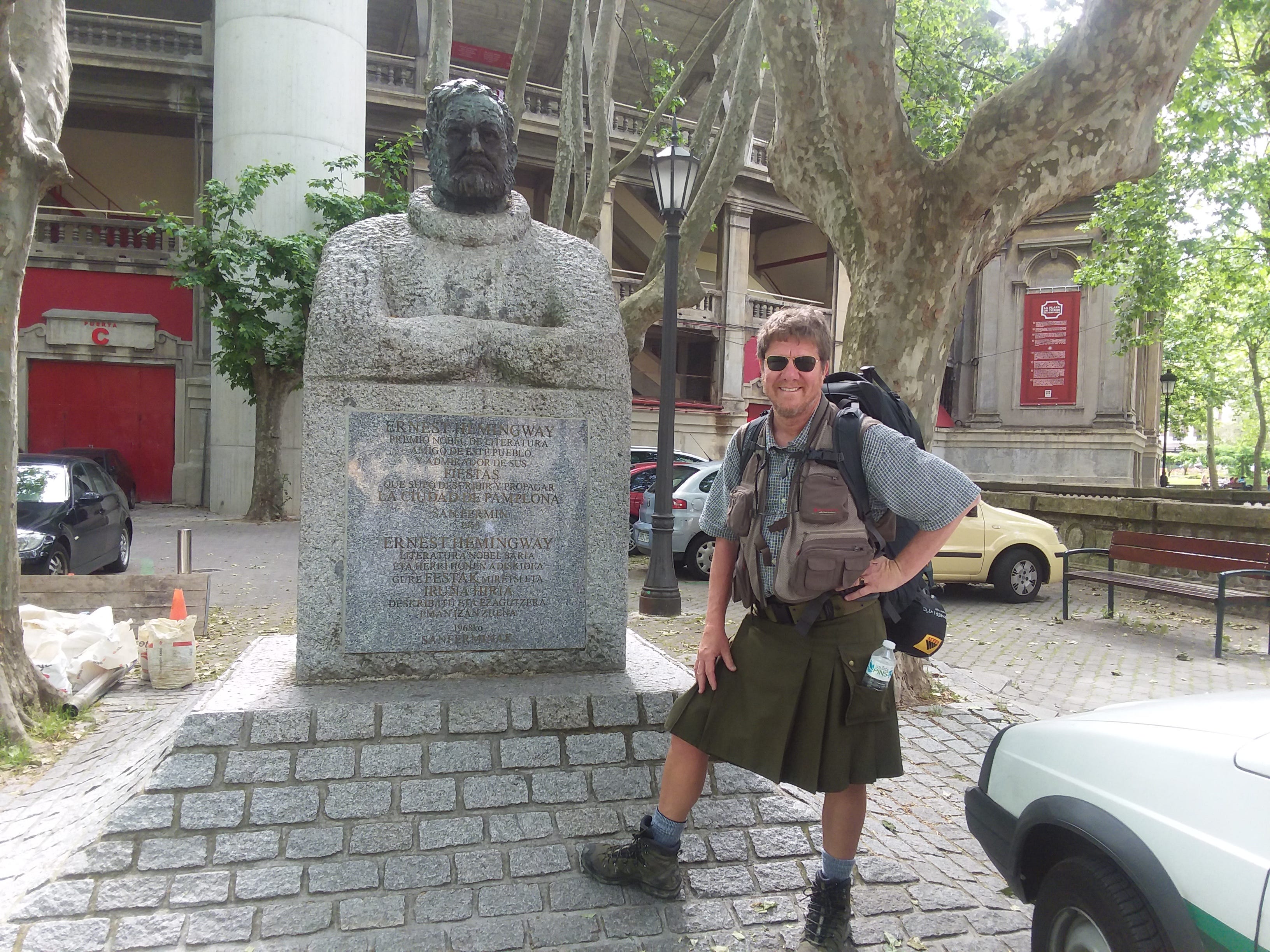
An American Humorist Staggers Across Spain, in Search of Happiness, Truth, and a Cold Beer
For someone engaged in the pursuit of happiness, I´m not very happy.
Everything hurts, and I’m pretty sure I’m dying.
The rain in Spain is falling mainly on… me.
I´m slogging up a hill, chatting up the Lord, promising Him if it’s my time to give up the ghost—hey, no hard feelings.
In the distance, through my rain soaked glasses, I see—a very, very long way away—my current destination: The spot where, upon arrival, I’ll be only very, very far away from my final destination.
In times like these, one must stay positive.
Spiritual thoughts are meant to be soothing my brain, but no dice; my brain is too busy arguing with me about stopping—and since my brain is, well, pretty-much me, it’s safe to say there’s some confusion in the frontal lobe.
This morning I received a text from a friend, asking, “What do you think about all day?”
It’s a good question. The intellectual side of me yearns to respond with flowing prose about my new-found discoveries, but the last three days worry me. Deep thoughts simply aren’t happening. Not a single revelation. In fact, this is a compilation of the previous hour’s thoughts:
I wonder if I’m halfway? I gotta be halfway. My feet hurt too bad not to be halfway.
Etcetera.
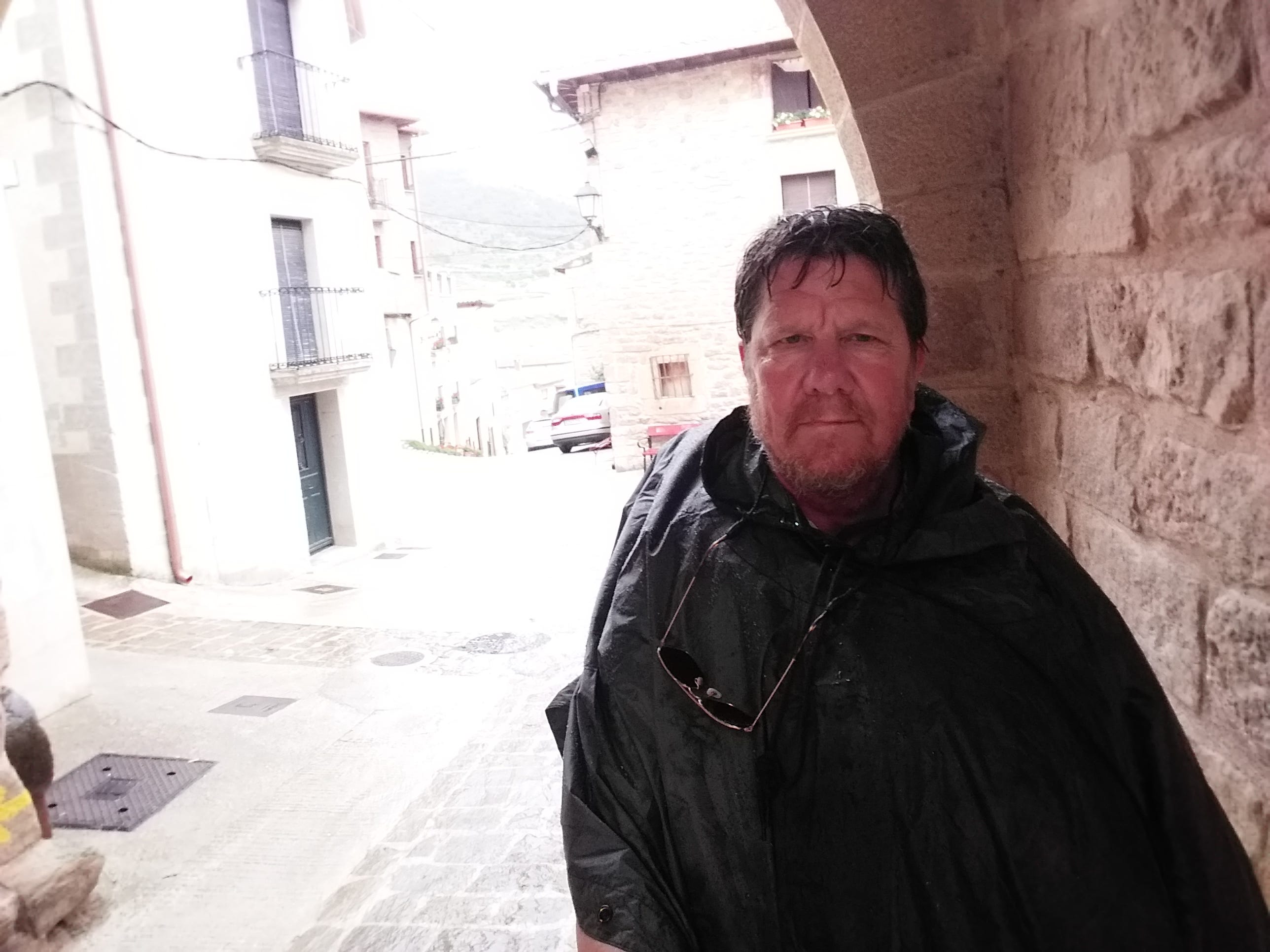
When the entire point of this journey is to think, these are not the thoughts one seeks.
The trudging continues. My right shoulder hasn’t felt like this since the last time I accidentally drove a railroad spike through it.
Crunch. Crunch. Crunch.
I am on a pilgrimage across Northern Spain on the Camino de Santiago—the goal of this lunacy is to ponder the train wreck that is my life, discover the root-source of happiness, and think through some theological questions.
At the moment, the pursuit of happiness is on hold, as I’m pursuing a place with a roof where I can get a beer. And that seems to be somewhere far over the horizon.
What inspired this journey to the lunatic fringe?
I’ll get to that, but I can’t focus right now. My feet are killing me.
Chapter One
A black and white view of the world is the ghost that haunts me.
At least, that’s what my shrink tells me. And my wife. And pretty much everyone I know, except my dog, who thinks of me as the Divine and Loving Lord of Walks, peace be upon my name.
I admit—I struggle with shades of gray, unless of course it’s me in the gray, in which case that particular shade of gray is a fine and righteous shade. If people would just agree to let me decide on what’s black/gray/white, oh what a fine place the world would be.
By way of a Black vs White example, I might respect George Washington for admitting he laid the blade to my Cherry Tree, but that wouldn’t change the fact he toppled my tree without my permission. Old Georgie Boy and yours truly would’ve faced off out there on the green with Burr and Hamilton.
Perhaps you are more of a live and let live person. I should be. And want to be. I don’t want to be that guy calling fire-and-brimstone down on another driver for failing to use their blinker, and yet here I am, killing it.
Assuming my prediction is right and you’re a loving, kind, and forgiving person, and I’m, uh, me, we share one thing in common: Our humanity. And as result, we both seek happiness.
Pursuing happiness is no small task, as for most people finding it requires connecting with some basic-yet-complex realities: Do we have the fingerprints of a Creator on us? Are we simply cosmic dust, thrown off from some intergalactic unpleasantness a grillion years ago? Is there a religion that is indeed The Way? And are we even meant to be happy… or are we meant to draw our last breath thinking, “Whew. Glad that’s over.”
For a myriad of reasons, time likely deprives you of the luxury of delving too deeply into these issues. It certainty does me. Time is a precious commodity in our brave new world.
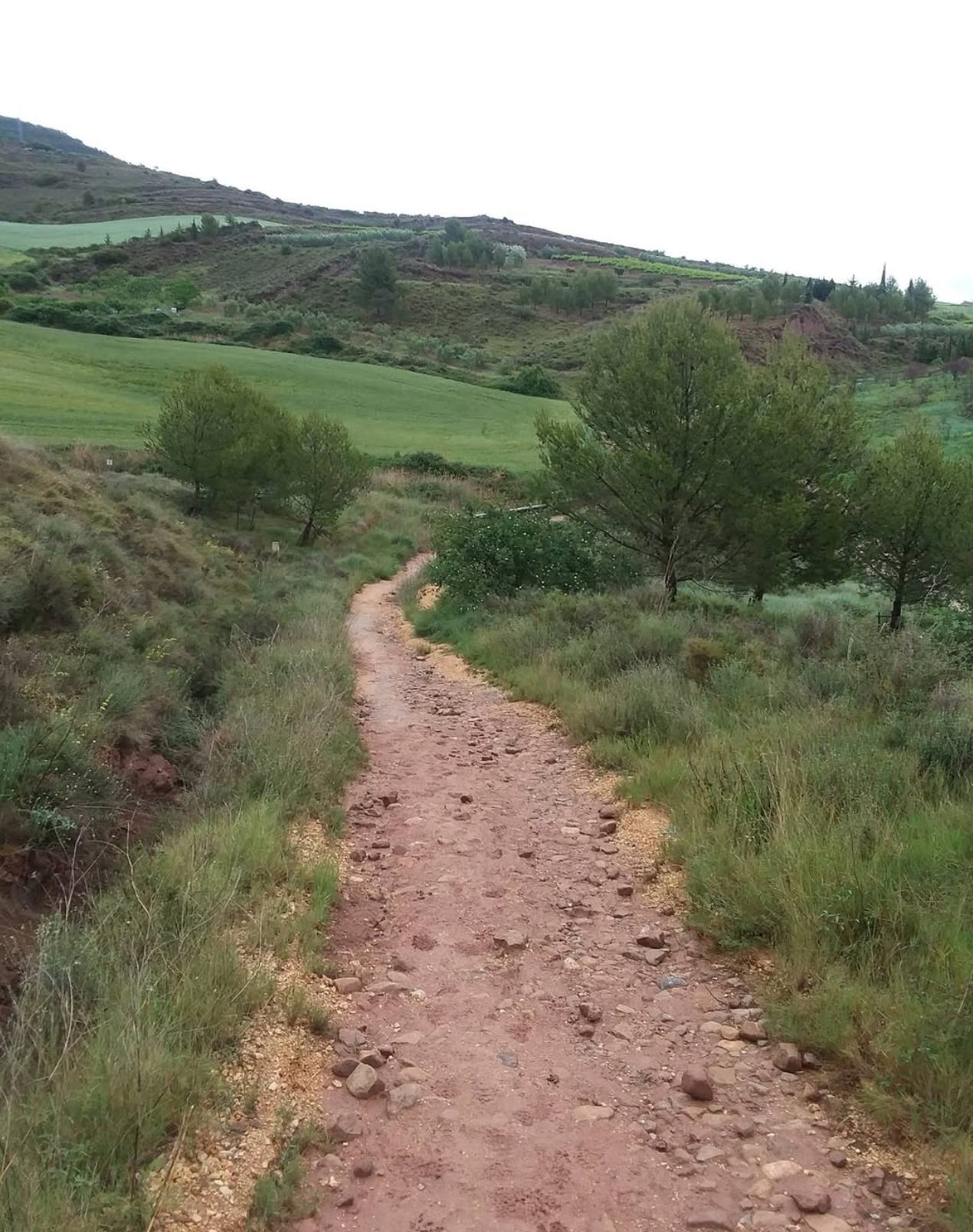
Some people find exercise a good time for contemplating happiness, but—for me— deep thinking is hindered by the fact that all I can think about is reasons to stop exercising.
Some find meditation helpful, but that particular discipline also evades me. Mentally connecting with “nothingness” isn’t needed, as my checkbook does that for me on a daily basis.
Some find risky endeavors to be a mind-clearing experience-- every brush with death furnishing keener insights into life. As a younger man I too engaged in such an approach, skydiving being my choice for cheating death. Then, one day in the midst of a free-fall, it dawned on me the sport was failing to provide a reason for living, but could certainly provide a reason for dying. Perhaps channel surfing is more appropriate for a couch potato like me.
For several months now I’ve thought, and struggled, and thought some more about my life and the role happiness should play in it. Quite frankly, there’ve been more than a few gut punches in recent years, so a better frame of mind is obviously a goal.
I’d tell you about my maladies and misfortunes, but you’d no doubt respond with, “Oh, yeah? You wanna hear about bad things happening to good people? Well, listen to my story…”
Then you’d tell me your woes, and I’d respond with, “Oh, yeah? You wanna hear about…”
You get the picture.
We’re all fighting our own battles. Life is bloody, red in tooth and claw. It would’ve been nice if that “Dream Big” graduation speech contained at least one nugget of truth. Your parents never wanted to tell you the truth, but at least the person at the podium should have:
Class of 1985… College is over, and you’re about to find out why your parents drink.
A few of you are brilliant or talented, and you will go far.
A few of you will get lucky, or succeed through sheer tenacity.
Most of you? The world you are bound for is hard.
But not hard like you’re thinking. You think getting your degree in beer drinking was hard. No, this is hard like serving as your own defense attorney in North Korea after you got caught eating a second serving of bark. Like trying to convince a Congressman that interns and free meals are off-limits. Your current hopes are on par with your hopes that the baby Gazelle on NatGeo—the cute one with the broken leg—is going to survive those four lions.
The only good news is that all bleeding eventually stops.
Right now, your parents are aghast. Not because I’m telling you this, but because they just realized my eight-sentence speech has offered more value than the 4-year degree they just paid for.
So, as you move forward in life and fail… fail with gusto!
Good luck, future worker drones! Good luck! You’re gonna need it!
However, like all graduation speakers, mine lied. Thus, my destiny centered on future greatness; first as a Marine fighter pilot, then as—Pfft, I can’t even remember. Something.
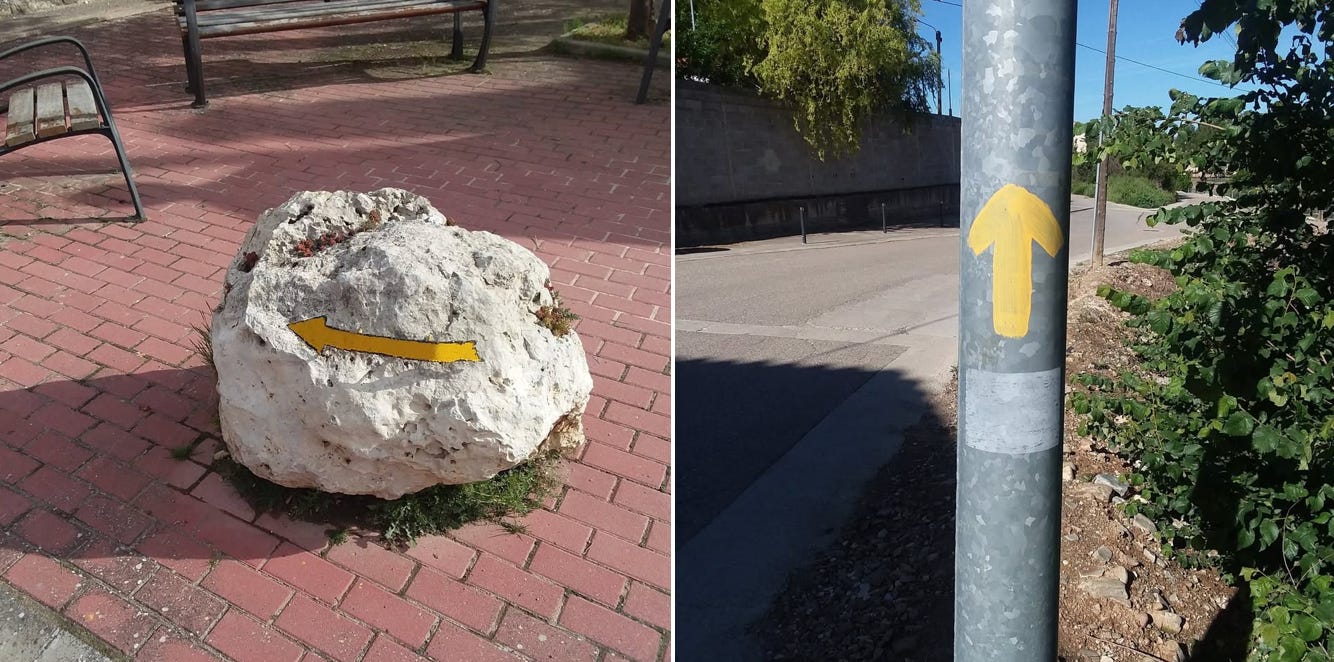
During the past couple of years I’ve fallen into some degree of despair about the disappointments of my previous decade. But it’s time to move on beyond those days and embrace the reality of, uh, Reality. Time to make peace with the past, and embrace the present. As my Marine buddy James Raymond once told me in the Officer’s Club, “Hopes and dreams die hard—but their shadows are what makes us who we are.”
Time to step out of the shadows.
In pondering the past, my brain drifted way backwards—like 40 years back. Back to my Mum’s solution for every question or complaint during the first twelve years of my life. It went like this: Hush, now. Go outside and play. Go for a walk.
Chapter Two
My Mum is a very wise lady, and if going for a walk yields a remedy for everything, then a walk it would be—happiness certainly falls under the category of “everything.”
Since I’m an American, my walk needed to be a long walk. Bigger! Better! ‘Murican! It called for a genuine Vision Quest, the discovery process undertaken by American Indian Braves-to-be seeking their place in the circle.
I decided to research the topic, as some professional looking documentation might look good when submitting a mental health claim to my insurance company. My research led to exciting news: Throughout all of history, mankind’s primary vehicle in the pursuit of knowledge and meaning is…walking.
The story of walk-abouts harkens back as far back as mankind itself. Early man loved to walk, and wandered in every direction. One can’t help but reflect on some of their decisions when they reach the places they stopped:
Africa
“My beloved wife! I have led us to a most excellent place, no? Gather the family. I wish to revel in their praises.”
“Your eldest son has been eaten by that thing called a lion.”
“Oh.”
“Your oldest daughter has been swallowed by that thing called a crocodile.”
“Oh.”
“Your middle son has been gored by that thing called an elephant.”
“Oh.”
“Your youngest son has been trampled by that thing called a Buffalo.”
“Oh.”
“Your infant daughter has—“
“Please! Stop! I’m sorry!”
“Sorry you led us here?”
“No! Sorry I married you. Mother warned me you’d be a complainer.”
Arctic Circle
“My sweet and hardworking wife, that was an excellent whale blubber pate, and the seal blood pudding was the best ever—come and give me a kiss.”
“Why don’t I give you an Eskimo Kiss instead?”
“What is that?”
“We rub noses.”
“Why would we do that?”
“Because the last time we kissed I was frozen to your stupid face for a week.”
Australia
“Woman! Is our new continent not to die for?”
“It is.”
“Really? I was afraid you didn’t like it.
“I don’t. I hate it.”
“You just said it’s to die for.”
“It is—every spider and snake is deadly poisonous, crocodiles eat everything that goes into the river, Great Whites eat everything in the ocean, and dingoes eat everything that stops to rest. So, yes— It’s very much to die for.”
“Oh. Ah… Woman! Is our new continent not an exciting adventure?”
These realities alone should’ve given a hint to our great-great-great-grunt-parents that travel in general is a bad idea, yet onward and outward they went. Even when written history appeared—and we enjoyed the opportunity to learn from each other—the thirst for discovery remained. Going for walks seems to be in the human DNA. The examples are legion, but let’s examine some of the well-known ones:
The Persian Empire began walking about, and conquered most of the sand-covered world. Traveling under the command of Xerexes the Great, they shook the ground when they walked, and drank the rivers dry. Walk and kill. Walk and conquer. Walk and enslave. They discovered new lands, the thrill of victory, then finally the meaning of “the Spartan work ethic.”
After the Persians decided to do less traveling and returned home to garden and such, Alexander the Great launched his great walk-about, and walk-abouted right into the Persian vegetable patch. When the two empires collided, Persia discovered the word “Great” applied more to Alexander than Xerexes.
Shortly thereafter, Alexander discovered the meaning of the words “Oh, great” when he dropped dead.
The Romans currently hold the title for Heavyweight Walkers of all History. They walked all over the known world, being lousy neighbors and defeating nation-states, usually with one spear tied behind the togas. Their walk-about lasted several centuries, and may have gone on longer, but they grew lazy and failed to do much when the Vandals, Goths, and Huns appeared outside the gates and began spray painting the walls and slashing chariot wheels. (You’d think the names of these tribes might have provided a hint concerning their intent). After a brief game of, Red Rover, Red Rover, hand your empire right over, the Romans ended their walk-about for good.
At this point, there can be only one conclusion: Walking about is a bad idea, and not worth the discoveries. Despite this, the ache for travel follows us right into recent history.
For a while the British Empire was overwhelmed with wanderlust, and colonized nations all across the world. They discovered the thrill of power and wealth—and likely thought those things might be the true source of happiness. Trouble began with American Colonists, then the Boers, then the Indians (Dot not Feather), then the Africans, and England found itself as overextended as Winston Churchill’s shirt buttons. Shortly thereafter they discovered the concept, “Be it ever so gloomy, there’s no place like home.”
Germany discovered walking about Europe with military weapons and a bad attitude will get you nowhere but dead. In fact, they learned the lesson twice within 25 years, and during Teachable War #2 discovered traveling through Russia in the winter is… something they should’ve learned about from the Eskimos, or at least the French.
Japan discovered that traveling all over the Pacific Islands can be surprisingly exciting at first, but end with surrender and a couple hundred thousand military-age males stuffing their Sepuku sword where the Rising Sun don’t shine.
Even America fell for the romance of travel, and that addiction led to wars in places in awful and unwelcoming places: Korea, Vietnam, Cambodia, Laos, Beirut, Iraq, Kuwait, Somalia, Iraq and Afghanistan. If we look to the American government as our professor of history, one bit of knowledge seems clear: The definition of insanity is doing the same thing over and over, but expecting different results.
Studying the history of mankind’s walk-abouts makes one thing very clear: Wandering, seeking, and discovering have, historically, been a catastrophically bad idea.
But then there’s this fact: All of recorded history has nothing on my Mum’s wisdom, so my research continued.
But where to go?
For someone like me, many issues demand consideration when pondering a walk-about: The financial cost, and— that’s it. The cost.
As a writer, I can find time to do pretty much anything. The only touchy issue concerns spousal approval. However, since we live in a 42 square-foot condo and I’m always home typing nonsense, getting permission from my spouse wouldn’t be hard— the smart money would bet on her approving a trip to Behead-me-stahn if it got me out of the house.
Asia
A popular walk-about amongst the younger folk involves exploring the celestial mysteries of Asia. The Asian culture is very, very different than America’s and thus feels… rebellious. Rebellion can be a good and freeing thing, provided it doesn’t include an oriental-characters neck tattoo, which does little more than free you from the burdens of a white-collar job.
Asia also offers a plethora of cool temples, statues and pagan-ish idols, some even partially covered with jungle-type flora. This has a ring of Indiana Jones danger and discovery, for which adventurous youth inject vast sums of money into the local economy. The injection of capital into the tax base is critical, as someone must provide the money to pay the arborist to keep the jungle-flora around the temples healthy, a bit shaggy, and wild in appearance.
My time in the Marines included some time in Asia, but failed to provide much personal insight. However, a confession is required: Everywhere I went was with a group of six-foot white and black men, so we failed to exactly blend in. The fact we were often armed also eliminated any sort of peaceful Buddah-vibe, so the locals hesitated to invite us in for the tea ritual.
Asia offers, of course, some extremely manly traditions, like disemboweling yourself if you spilled your Saki at a dinner party, but that strikes me as the opposite of pursuing happiness. In the end, the Asian idea just didn’t jive with my quest, so it received the Kung-Fu-chop.
Central America
Another fanciful exploration is a trek through Central America. Central America offers young travelers an upfront seat to the mysterious Mayan culture, and the architectural monuments of this great civilization. Fortunately, the Mayans can be viewed as “cool,” thanks to the Central American Department of Tourism: The part of the culture where they appeased their gods with human sacrifices has been pretty-much eliminated from the brochures.
Life moves at a slower pace in Central America, appealing to Americans of all ages. Lingering over lunch, sipping beer under a palm tree, and strolls along the beach provide ample opportunities to chat with others about happiness, and ponder the mysteries of the Christian faith.
Alas, my wife and I once embarked on a three-week walk-about through Belize, and couldn’t afford to stay at one of the enclosed and luxurious resorts. This was fine, as we hoped to connect with the “real” Belize… the one vibrant and alive, settled in the footprint of the British Empire under its previous name British Honduras. My luggage even included a Panama Hat to wear in the ceiling-fan cooled bars, where we’d chat with importers and ex-pats and men of nefarious character.
The people of Belize are a delight, and in their kind and welcoming personalities we witnessed happiness with life. Unfortunately, it is a nation of loving people and a horribly corrupt government. Perhaps most alarming to a husband responsible for his wife was the absence of little safety nets we enjoy in the States… things like law enforcement, hospitals, roadside assistance, and the 2nd Amendment. After 21-days of driving in circles, a hurricane blasted through Belize City, and we waded through 2-feet of hotel-lobby-water to flee to the airport.
Europe
A walk-about through Western Europe stimulates the senses, what with all the art and culture and things to do before Happy Hour: Paris, Munich, Venice, Brussels, that place from The Sound of Music—what’s not to love? Like a Siren’s song of seduction Europe called to me, as I envisioned myself riding a bike along country roads with a beret and a baguette. Maybe some cheese strapped to the handlebars.
What joys I’d discover in the paintings of the Masters! In the finest sculptures ever created! In the heart of the Cathedrals throughout the continent, built as a testament to the faith of the era!
My dreams of Europe were muted after a few Google searches revealed the harsh reality that a beer and a burger in the nice areas costs about $35. Much of my destination-desirability is based on beer and burger economics. There’s also the pesky fact that I don’t much care about arts and architecture.
Europe was Francophiled into the round file.
‘Merica!
The United States lends itself to the greatest potential walk-about of them all, but the place is so big—and because of urban sprawl our public transportation remains virtually non-existent. Yes, you can get somewhere without a car, but once you get there you can’t get anywhere else. By way of example, try walking through Northern California on foot. My friend in Montana drives 300 miles for a pack of cigarettes.
Another problem with traveling America centered on my desired goals for a true Vision Quest. Indian Braves searched for their place in the circle by living in a cave for a month, smoking peyote, and wrestling with poisonous snakes and terrifying demons. Should I attempt my Vision Quest in America, here’s exactly what I’d be doing: Wrestling with bed bugs in Motel 42, and yelling at the evening news.
As smoking peyote is now illegal, and all the cool caves sit on government land, the U.S. of A. got the tomahawk chop.
Tibet
I explored the idea of a pilgrimage to Tibet. The Dali Lama’s homeland just seems like the ultimate location for internal exploration, complete with all the cool ideas like stripping away all of life’s luxuries. But for a guy living on a freelance writer’s income, a lack of luxuries is already a lifestyle, so that didn’t seem helpful.
Being a Christian also reduces the spiritual appeal of rocks with souls, but still—the whole prayer flag and gong thing is pretty righteous.
In the end, one whopper-sized event struck Tibet from the list. It goes like this:
While speaking with my brother-from-another-mother Mike about his Tibetan experience, he gave me an account of a walk-about by two best buddies exploring the region. At some point, one of them experienced altitude sickness, even though they were hiking lower than the Everest Basecamp… where climbers acclimatize themselves before watching Sherpas lug all their stuff up the mountain.
So, Buddy #1 is feeling poorly.
Buddy #2 gets spooked, because, well, they’re on some goat trail in the middle of freaking Tibet, and goat-cart-sized ambulances aren’t exactly on-call to drag you down to lower elevation.
Buddy #1 gets to feeling all woozy hard-to-breathe poorly.
After a bazzion hours, some Tibetan comes along with a donkey. The very kind Tibetan chucks Buddy #1 up on the donkey, and together they proceed a trillion miles down the trail to a hut. They schlep Buddy #1 into the tent, and there’s this Holy Looking Dude, who takes one look and realizes the kid’s search for the unknown is about to become a search of the unknown.
The Holy Dude, however, looks serene and confident, and starts feeding the sick guy tea with, uh, magic stuff in it. Buddy #2 feels much better now that someone Holy is doing holy things, and goes outside to sleep outside. He comes back in, and the Holy Looking Dude acts out a very convincing charade entitled “Your buddy is dead.”
What?
Dead?
People don’t just die on vacation. Sure, maybe crushed by a boulder or overcome by an avalanche, but they usually earn that kind of death by doing something Darwinian. You don’t just walk along and die.
Of course, Buddy #2 is now saddled with a coffin-dead pal, and a seven-day walk to the nearest place with an electrical outlet. What do you do? He weighs his options, then begins walking back solo, pondering his list of action items:
-- Find civilization.
-- Call his buddy’s parents and tell them their son has achieved total consciousness.
-- Find some Sherpas willing to walk for a week, load up a body, and walk back.
-- Figure out how to export a body from an 8th World Country to America.
Tibet is not a Vision Quest. It’s Hell, with really thin air.
I laid the gong to Tibet.
Really hard corps
I looked into the Holy Triumvirate of American walk-abouts: The Appalachian Trail, The Pacific Crest Trail, and The Continental Divide Trail. I’d heard tales of these monsters, but knew very little about them—save for the stories of physical pain, hunger, and loneliness. Am I man enough? Is my determination to discover happiness and truth strong enough to accept the challenges?
The Google provided all the details, and it turns out the tales are not, in fact, tales, but facts. So what? If men like Lewis and Clarke brawled their way across an untamed and unexplored America, can’t I handle the discomfort and challenges of a tamed trail? A trail now devoid of understandably angry locals looking to give me a reverse Marine Corps haircut? Isn’t the search for truth worth it?
What’s that? The shortest one is 2,184 miles?
Yeah, uh, no. I’m looking for ideas about truth and happiness, not looking to ask God my questions face to face.
I wanted an answer to my walk-about question worse than Henry XIII wanted a divorce. Then, as decision-despair descended, a friend came along—a graphic designer from a freelance job we’d worked together. She was younger and sort of crunchy, and seemed the type to do more on a vacation than drink Pina Coladas at an all-inclusive resort. I asked her, “What’s the coolest place you’ve ever been?”
“It was really weird,” she said. “A friend of mine invited me to meet her in Spain, and we started walking along this route—I think it was a pilgrimage or something. You’d hike for part of the day, then arrive at these cool hostel places. You’d meet all these crazy people who were walking the route, and drink red wine and eat until it was time to go to bed.”
I knew of this place. It simply never worked its way into my McBrain.
“Camino De Santiago,” I replied, then asked the critical question: “Is it expensive?”
“Cheaper than staying home,” she said.
The Camino De Santiago is a Christian Pilgrimage running across Northern Spain and ending at a Cathedral in Santiago de Compostela where the bones (minus the head) of Saint James are rumored… uh, believed… uh, known to be interred. The pilgrimage is 791 Kilometers or, for us in ‘Merica, 490 miles. The minimum number of walking days to complete the trek is generally agreed to be thirty, and that’s with no days of exploring, chatting up the locals, or in my case writing.
The die were cast.
My bride and I agreed on three weeks, a number that (I confess) secretly delighted me: I could shoot for a goal of covering 250-miles, but not feel all sad and defeated for failing to walk the entire route. Three weeks allowed me a great deal of time for grinding on the Camino afoot, but also some time to write and explore the culture of the Camino and the villages that line the route.
Foreshadowing: Before you go pooh-poohing my plan, Dear Reader, there are tens of thousands of Pilgrims each year that only wish they’d planned the same way. Unless you are young, very fit, or committed a great deal of time to training, setting aside 30-days ain’t gonna put you in Santiago de Compostela to catch your non-refundable frequent-flyer flight.
Three to four days on the Camino is when many Pilgrims admit to themselves they aren’t going to make it, and start hop-scotching a few legs in order to actually enjoy the experience. This is not to say people don’t make the entire journey—tens of thousands do every year—but making it in 30 days is strictly for those committed to the physical challenge… those attracted to gritting their teeth, grinding it out, and reveling in the pride of the accomplishment. (Wait, what’s that? Pride? Aha! That’s it! I’m not doing the whole Camino as I want to avoid falling prey to the sin of pride. Note to self: Edit the section above.)
Anyway, the Camino de Santiago offered all the elements I sought: Travel, fresh air, excellent beer and burger economics, a search for happiness, and the chance to ask Pilgrims from across the world important questions like, “Do your feet hurt as bad as mine?”
Time to start buying some gear.